

.svg)
.svg)
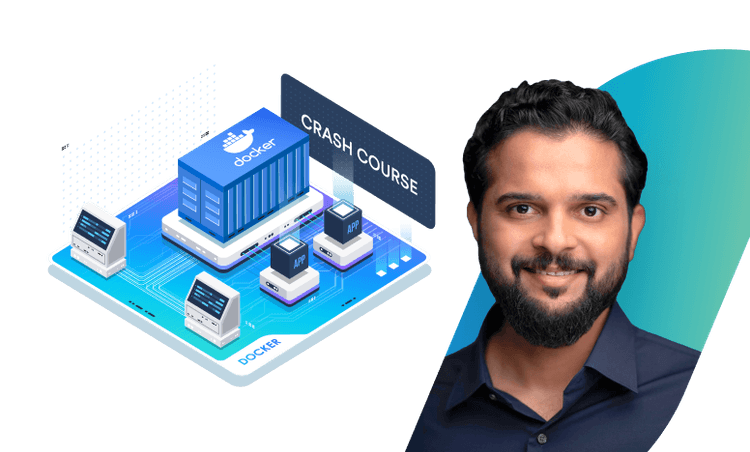
Crash Course: Docker For Absolute Beginners



What you’ll learn
Our students work at..


Description
Kickstart your containerization journey with a practical Docker tutorial designed for absolute beginners. This hands-on crash course focuses on the essential Docker CLI commands you’ll use every day. No prior Docker or DevOps experience required—just basic command-line familiarity. Through clear explanations and guided exercises, you’ll quickly learn how to work confidently with containers and images using real-world workflows.
What you’ll learn:
- Core concepts: What containers are, how they differ from virtual machines, and why Docker matters in modern development and DevOps.
- docker run: Launch your first containers, understand image auto-pull behavior, and name containers for easier management.
- docker ps: List running and stopped containers (including docker ps -a) and read essential container status details.
- docker stop: Safely stop containers to avoid data corruption and ensure graceful shutdowns.
- docker rm and docker rmi: Clean up your environment by removing containers and images to reclaim space and stay organized.
- docker pull: Download official images from Docker Hub and work with image tags (e.g., latest vs specific versions).
- docker exec: Open an interactive shell in a running container for troubleshooting and basic administration.
- Practice: Reinforce each concept with beginner-focused exercises that mirror real workflows.
Who this course is for:
- Developers, QA engineers, data scientists, and IT/DevOps newcomers who want a fast, practical introduction to Docker.
- Anyone seeking a simple, step-by-step Docker tutorial without prior container experienc
By the end: You’ll confidently use the fundamental Docker commands—run, ps, stop, rm, rmi, pull, exec—to launch, inspect, manage, and troubleshoot containers on Windows, macOS, or Linux using Docker Desktop or Docker Engine.
What our students say

About the instructor
Mumshad Mannambeth, Founder and CEO of KodeKloud, is renowned for revolutionizing online learning in DevOps, Cloud Computing, and Automation.
Mumshad has also worked for Dell EMC, he held various roles including Solutions Architect/Developer and Storage Operations Specialist, where he specialized in storage automation and cloud deployment solutions. His contributions in application modernization and cloud migration are notable.
Mumshad has led teams in APAC, focusing on DevOps and Cloud Automation. His expertise in designing and deploying applications on Microsoft Azure and developing CI/CD pipelines has been pivotal in his professional journey.
He's widely recognized as a Knowledge Sharing Author and has been honored with Excellence@EMC awards in multiple categories.
Mumshad Mannambeth's blend of technical expertise and educational innovation has made him a popular figure in the tech community, and his work at KodeKloud continues to impact and upskill engineers globally.


Frequently Asked Questions
Who are KodeKloud courses for?
KodeKloud courses are designed for learners at different skill levels, from beginners to experienced IT professionals looking to develop or strengthen their technical skills.
Do KodeKloud courses include hands-on practice?
Yes. Many KodeKloud courses include hands-on labs and practical exercises that let you apply what you learn in real-world environments.
Do I need any prior experience to take a KodeKloud course?
Prerequisites vary by course. Each course page provides information about the recommended knowledge or experience you may need before starting.
Can I learn at my own pace?
Yes. KodeKloud courses are designed for self paced learning, so you can learn according to your schedule and revisit lessons and practice activities as needed.
Can I access KodeKloud courses on mobile devices?
Yes. KodeKloud can be accessed through supported web browsers and mobile devices, allowing you to learn from different devices.
Do KodeKloud courses provide certificates?
Certificate availability depends on the course and your KodeKloud plan. Check the individual course page or your account for the applicable certificate details.
How long does it take to complete a KodeKloud course?
Course completion time varies depending on the course length, your prior experience, and how much time you spend on hands-on practice.
Can I practice while taking the course?
Yes. Courses that include hands-on labs allow you to practice concepts as you progress through the lessons.
How do I start learning a KodeKloud course?
Choose a course that matches your learning goals, review its requirements and curriculum, and select the available subscription option to start learning.
Get access to KodeKloud’s all courses.
Get access to KodeKloud’s all Pro courses.
Get access to our Labs now!
190+
1280+
75+


Expand Your Skills in Other Domains
AWS Certified Cloud Practitioner (CLF-C02)


.svg)

GCP Cloud Digital Leader Certification

AZ-104: Microsoft Azure Administrator

DevOps Pre-Requisite Course
Fundamentals of DevOps
DevOps Interview Preparation Course
AI Infrastructure: LLM-D, vLLM and GPUs
AI-900: Microsoft Certified Azure AI Fundamentals
AI Agents Fundamentals

Kubernetes for the Absolute Beginners – Hands-on Tutorial
Certified Kubernetes Administrator (CKA)
Certified Kubernetes Security Specialist (CKS)
AWS Solutions Architect Associate Certification

AWS Lambda

Kubernetes for the Absolute Beginners – Hands-on Tutorial
Certified Kubernetes Administrator (CKA)
Certified Kubernetes Application Developer (CKAD)

.svg)
