Sync Your Argo Knowledge Before Exam Day

Take on 25 practice questions across four Argo domains.
No Credit Card Required
HOW TO PREPARE

Everything You Need to Know First

Warm-up topics before the test.
  • Kubernetes Fundamentals: Familiarity with Pods, Deployments, Services, and reading Kubernetes manifests.
  • Git and GitOps Concepts: Understanding of Git workflows and the idea of Git as the source of truth for deployments.
  • CI/CD and Deployment Strategies: General awareness of pipelines, plus canary and blue-green releases.
PRACTICE TEST

Put Your Knowledge to the Test

25 multiple-choice questions, including ones built around command output
What is the role of the EventBus in Argo Events?
It transports events from EventSources to Sensors
It stores artifacts produced by triggered Workflows
It evaluates dependency conditions before triggers run
It receives webhooks from external systems
A
The EventBus is the transport layer between EventSources and Sensors, backed by a system such as NATS JetStream or Kafka. Receiving webhooks is the EventSource's job, and evaluating dependencies is the Sensor's.
Argo Events
25
Select One
A Workflow should be submitted only when events from two different sources have both arrived. Which Argo Events component evaluates these dependencies and runs the trigger?
EventSource
EventBus
Sensor
WorkflowTemplate
C
A Sensor declares event dependencies, evaluates conditions across them, and executes triggers such as submitting a Workflow. EventSources produce events, and the EventBus only carries them.
Argo Events
24
Select One
A GitHub webhook must enter Argo Events as an event. Which component receives the webhook and turns it into an event?
Sensor
EventSource
EventBus
Trigger
B
An EventSource receives or watches an external source, such as a webhook, and publishes events to the EventBus. Sensors consume events, and triggers are the actions that Sensors run.
Argo Events
23
Select One
A canary Rollout has 4 replicas and no traffic router configured. A step sets setWeight: 30. What should the engineer expect?
Exactly 30% of requests reach the canary
Argo Rollouts configures the cluster's ingress to send 30% of traffic
The step fails because setWeight requires a traffic router
Traffic is approximated by the ratio of canary to stable Pods
D
Without a traffic router, Argo Rollouts adjusts replica counts to approximate the weight, and with 4 replicas it cannot match 30% exactly. Precise percentages require a traffic routing integration such as an ingress controller or service mesh.
Argo Rollouts
22
Select One
A canary Rollout with a traffic router runs background analysis from an AnalysisTemplate. Partway through, the AnalysisRun exceeds its failure limit and enters the Failed phase. What does Argo Rollouts do?
The rollout aborts and traffic returns to stable
Continues to the next step and records a warning
Deletes the AnalysisTemplate so it cannot fail again
It treats the result as Inconclusive and pauses for approval
A
A failed AnalysisRun aborts the Rollout, which scales the canary down and routes traffic back to the stable ReplicaSet. The Rollout then reports a Degraded status until it is retried or updated. An Inconclusive result behaves differently and pauses the rollout, and a single failed measurement does not fail the run unless it exceeds the configured failure limit.
Argo Rollouts
21
Select One
A blue-green Rollout sets autoPromotionEnabled: false. The new ReplicaSet becomes fully available. What is the state of the two Services?
Both Services point to the new ReplicaSet
The activeService switches to the new ReplicaSet automatically
preview points to the new ReplicaSet; active stays on the old one
Neither Service changes until the old ReplicaSet has been scaled down and deleted
C
With auto-promotion disabled, the rollout pauses after the new ReplicaSet is ready so it can be tested through the preview Service. Promotion switches the active Service to the new version.
Argo Rollouts
20
Select One
A Rollout uses the following canary steps. What happens after the rollout reaches 50%? strategy: canary: steps: - setWeight: 20 - pause: {duration: 10m} - setWeight: 50 - pause: {}
It waits 10 minutes, then moves to 100% automatically
It pauses indefinitely until someone promotes it
It aborts and returns traffic to the stable version
It moves straight to 100%, because the last pause has no duration
B
A pause with no duration waits until the rollout is promoted, for example with kubectl argo rollouts promote. Only pauses with a duration resume automatically.
Argo Rollouts
19
Select One
A repository has a Kustomize base and overlays for staging and production. How should an Application deploy the production configuration?
Point spec.source.path at the base and add production patches in the Application
Set spec.destination.name to production so Argo CD selects the overlay
Convert the overlay into a Helm chart before Argo CD can use it
Set spec.source.path to the production overlay directory
D
Argo CD detects the kustomization.yaml in the source path and builds it, so pointing at the overlay deploys the production configuration. The destination name selects a cluster, not an overlay.
Argo CD
18
Select One
A database migration Job must run and succeed before Argo CD applies the new Deployment in each sync. Which approach fits?
Annotate the Job with argocd.argoproj.io/hook: PreSync
Place the Job manifest first in the YAML file
Put the Job in a separate Application that syncs manually
Set selfHeal: true on the Application
A
PreSync hooks run before the main sync, and the sync continues only if they succeed. Manifest order does not guarantee sequencing, and self-heal only corrects drift.
Argo CD
17
Select One
A platform team needs the same Application created for every cluster registered in Argo CD, including clusters added later. Which feature fits?
An App of Apps parent Application with one child manifest per cluster
An AppProject with a wildcard destination
An ApplicationSet with a cluster generator
A CronWorkflow that creates Applications every hour
C
The cluster generator produces parameters for each registered cluster, and the ApplicationSet controller creates or removes Applications as clusters change. An App of Apps requires a manifest for each new cluster.
Argo CD
16
Select One
After Argo CD deploys a Helm chart, an engineer runs helm list in the destination namespace and sees no release. Why?
Argo CD installs Helm releases into a hidden namespace
Argo CD renders the chart with helm template itself
The chart failed to install and Argo CD rolled it back silently
Helm releases created by Argo CD are listed only when running helm list --all-namespaces
B
Argo CD uses Helm only to generate manifests and then manages them itself, so no Helm release record exists. The application lifecycle is managed by Argo CD rather than by helm install.
Argo CD
15
Select One
An Application deploys a Helm chart. Production must use the settings in values-prod.yaml from the chart's directory. Which Application field sets this?
spec.source.kustomize.images
spec.syncPolicy.syncOptions
spec.destination.namespace
spec.source.helm.valueFiles
D
valueFiles lists values files, relative to the chart path, that Argo CD passes to Helm. The Kustomize and sync options do not apply to Helm values, and the destination only sets where resources go.
Argo CD
14
Select One
An organization wants to limit which Git repositories, destination clusters, and namespaces a team's Applications can use. Which Argo CD resource defines these boundaries?
AppProject
The argocd-rbac-cm ConfigMap
ApplicationSet
A Kubernetes ResourceQuota
A
An AppProject restricts source repositories, destination clusters and namespaces, and allowed resource kinds for its Applications. RBAC controls what users can do, and ResourceQuotas limit resource consumption.
Argo CD
13
Select One
An Application shows Synced, but its Deployment has not reached the required number of available replicas. Which statement is correct?
Synced status always means that every resource in the Application is Healthy
Argo CD does not assess the health of Kubernetes resources
Sync and health are separate statuses
Health is based only on how recently the Git commit was made
C
Sync status compares live manifests with Git, and health status assesses whether resources are working, such as Deployment availability. A Synced app can therefore be Progressing or Degraded.
Argo CD
12
Select One
The same Application has selfHeal: true. Git declares 3 replicas for a Deployment, and an engineer runs kubectl scale to set 5 replicas. What happens?
Argo CD updates Git to 5 replicas to match the live state
The change stays until the next commit to the repository
Argo CD marks the Application Degraded and waits for a manual approval
Argo CD syncs it back to 3 replicas
D
Self-heal makes automated sync correct live changes that differ from Git. Argo CD never writes live changes back to Git.
Argo CD
11
Select One
An Argo CD Application has the following sync policy. A developer deletes a Deployment's manifest from Git. What happens to the Deployment in the cluster? syncPolicy: automated: prune: false selfHeal: true
Argo CD deletes it automatically during the next sync
It stays in the cluster and is flagged as requiring pruning
Argo CD recreates the manifest in Git from the live resource
The sync fails with an error until the deleted manifest is restored in Git
B
With automated sync but prune: false, Argo CD never deletes resources that are no longer in Git. It marks them as requiring pruning, and a manual sync with prune can remove them.
Argo CD
10
Select One
A Workflow must always run a cleanup template after its main steps finish, whether they succeed or fail. Which feature fits?
An exit handler set with spec.onExit
A final DAG task that depends on the previous task succeeding
A ttlStrategy that deletes the Workflow after completion
An activeDeadlineSeconds limit on the Workflow
A
The exit handler runs after the Workflow completes, whatever the result, and can read workflow.status. A task that depends on success is skipped on failure, and ttlStrategy only deletes the Workflow object.
Argo Workflows
9
Select One
A task occasionally fails because of transient upstream errors. It should be retried up to three times, with the delay doubling after each attempt. What should the engineer configure on the template?
activeDeadlineSeconds set to three times the normal duration
parallelism: 3 so that three copies run at once
podGC with a strategy that keeps failed Pods
retryStrategy with limit: 3 and a backoff with factor: 2
D
retryStrategy sets the retry count, and its backoff settings (duration, factor, and maxDuration) control the delay between attempts. The other fields limit runtime, parallelism, or Pod cleanup.
Argo Workflows
8
Select One
A CronWorkflow runs every 15 minutes. If the previous run is still going, the new scheduled run must be skipped. Which setting achieves this?
concurrencyPolicy: Allow
concurrencyPolicy: Forbid
concurrencyPolicy: Replace
suspend: true
B
Forbid skips a scheduled run while a previous one is still active. Allow runs them concurrently, Replace stops the old run and starts the new one, and suspend stops all scheduling.
Argo Workflows
7
Select One
A platform team maintains shared templates that Workflows in every namespace of the cluster must be able to reference. Which resource fits?
WorkflowTemplate in the argo namespace
CronWorkflow with a shared schedule
ClusterWorkflowTemplate
A ConfigMap mounted into every Workflow Pod
C
A ClusterWorkflowTemplate is cluster-scoped and can be referenced from any namespace using templateRef with clusterScope: true. A WorkflowTemplate is namespaced and is only available in its own namespace.
Argo Workflows
6
Select One
In a DAG, task gen declares an output parameter named result. How does a later task pass that value as an argument?
{{tasks.gen.outputs.parameters.result}}
{{steps.gen.outputs.parameters.result}}
{{inputs.parameters.result}}
{{workflow.outputs.parameters.result}}
A
DAG tasks reference earlier tasks with the tasks. prefix. The steps. prefix is used in steps templates, and inputs.parameters refers to the current template's own inputs.
Argo Workflows
5
Select One
A task produces a 2 GB report file that a later task must read. Which mechanism is designed to pass the file between tasks?
An output parameter whose value contains the whole file
An environment variable set on the later task's container
A ConfigMap that the first task updates with the file contents
Output and input artifacts backed by an artifact repository
D
Artifacts move files and directories between tasks through storage such as S3 or GCS. Parameters are for small values, and ConfigMaps and environment variables are not designed for large files.
Argo Workflows
4
Select One
A Workflow defines five templates. Which field determines the template where execution begins?
spec.entrypoint
The first template listed under spec.templates
A template that must be named main
spec.onExit
A
The entrypoint names the template that runs first. Template order and names do not matter, and onExit names the exit handler template.
Argo Workflows
3
Select One
A Workflow uses the following steps template. In what order do the steps run? steps: - - name: prepare template: prep - - name: test-a template: test - name: test-b template: test
All three steps run in parallel as soon as the Workflow starts
prepare, then test-a, then test-b, one at a time
prepare, then test-a and test-b in parallel
test-a and test-b in parallel first, then prepare
C
In a steps template, the outer list runs in sequence and each inner list runs in parallel. prepare is alone in the first group, and test-a and test-b share the second group.
Argo Workflows
2
Select One
A Workflow contains the following DAG. Task A succeeds, and the cluster has enough capacity. What happens next? dag: tasks: - name: A template: step - name: B depends: A template: step - name: C depends: A template: step - name: D depends: B && C template: step
B runs, then C, then D, following their order in the YAML
B and C run in parallel, and D starts after both succeed
D starts at the same time as B and C because it is a DAG task
All four tasks start together, because DAG tasks ignore dependencies
B
DAG tasks run as soon as their dependencies are met, so B and C start together after A, and the B && C expression makes D wait for both. YAML order does not affect DAG execution.
Argo Workflows
1
Select One
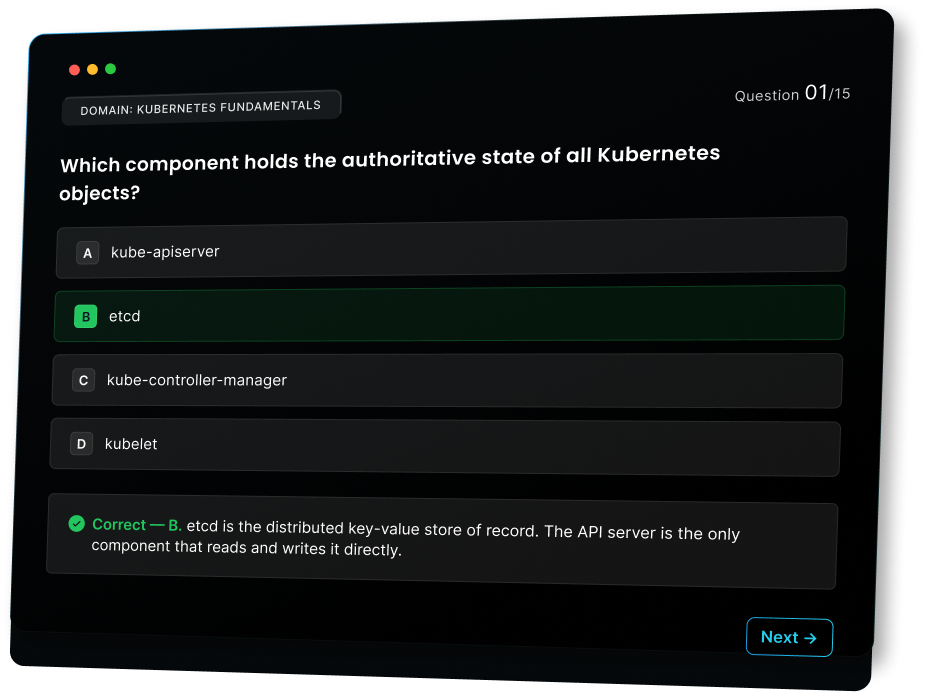
DOMAIN Question 01/00

0 of 0 answered
WHY HANDS-ON PRACTICE

Knowledge, Earned by Doing

The Argo exam rewards knowing which tool fits which job, not memorized YAML.

Build Real Exam Speed The exam gives you 90 minutes for 60 questions, an average of 90 seconds each. Repeated practice trains you to read a manifest fast, so you're not tracing specs under time pressure.

Know Your Weak Domains‍

Review every question you missed and spot the topics that need more work. Better to find them here than on exam day.

Realistic Scenario Questions‍

Exam-style questions, that are a mix of Workflows, CD, Rollouts, and Events items.

Reduce Exam-Day Anxiety‍

Familiarity with multiple-choice format removes surprises, so nerves don't cost you marks.

Reinforce Through Repetition‍

Spaced repetition on frequently tested concepts, like sync policies, DAG templates, and canary analysis, moves them from look it up to just know it.

Benchmark Against a Passing Score‍

Compare your score with the exam's 75% passing threshold and identify topics to review before exam-day.

HEAR FROM OUR LEARNERS

Real Learners. Real Results

Alhamdulillah 🙏! Thrilled to announce that I am now officially a Certified Kubernetes Administrator (CKA)! While Kubernetes, cluster orchestration, and container security are already central to my daily DevSecOps work, earning this certification is a great validation of those hands-on skills.Thanks to Mumshad Mannambeth and the KodeKloud team—their course and hands-on labs helped me a lot in preparing for this exam.The learning never stops! 🚀

Read Full Post

Imtiaz Ali
DevOps | SRE | Multi-Cloud | DevSecOps

Freshly certified: Certified Kubernetes Administrator (CKA)! 🚀Passing this hands-on, live-terminal exam was a great challenge. Paired with my AWS Certified DevOps Engineer – Professional, it reinforces my focus on bridging enterprise multi-account cloud governance with production-grade Kubernetes runtime operations.A special shoutout and big thank you to Mumshad Mannambeth, the KodeKloud team, and the Cloud Native Computing Foundation (CNCF) and Kubernetes (Official) community. The Certified Kubernetes Administrator (CKA) course was hands-down the best preparation for the live terminal environment! 🛠️Next stop: continuing to build resilient, developer-first platform foundations!

Read Full Post

Gaurav Dubey
Cloud Architect | Platform Engineer | AWS DevOps Pro | CKA

Cherishing one of my dreams - CKS Certified! ✨Last year, in October, when I cracked my CKA, my colleagues asked, “When is CKS?” 😂And I was like… bro. 😅Because it felt so much bigger. I also knew it wasn’t just Kubernetes anymore, but Kubernetes with a special layer of security - yeah, tightened Kubernetes.Back then, I used to look up to CKS like a child gazing at one of the stars in the sky.⭐Now, fast forward to today - I cleared it last week and officially became a Certified Kubernetes Security Specialist (CKS), thanks to the Cloud Native Computing Foundation (CNCF), The Linux Foundation and my company Aivar Innovations. 🎉That moment felt so special, and I’m incredibly grateful to all my colleagues, friends, and family for all the support. ❤️A mention of the resources I used: KodeKloud by Mumshad Mannambeth and Kim Wüstkamp’s CKS courses. I also had my colleagues supporting me with my doubts and anxieties before the exam. 😂Looking forward to applying everything I’ve learned in my work and continuing to grow in the Cloud Native and Kubernetes space. 🚀So, cheers to everyone who dreams, aspires, and inspires. Keep going and keep up the good work! 🥂And as I always say - God, keep it coming!! ✨

Read Full Post

Rima Sidique
DevOps Engineer | AI & DevOps Enthusiast

I've successfully passed CKA certification. Shout-out to Mumshad Mannambeth for his great CKA course and labs and to Omkar Shelke Killercoda CKA scenarios. Links: - https://lnkd.in/eZPVHJeR- https://lnkd.in/eEVyZdaZ

Read Full Post

Gabriel Rodríguez
DevSecOps Engineer

🎉 The Kubernetes journey continues… and this time, happy to say I’m officially a Kubestronaut! 🧑🚀🚀🎖️ 1 out of 242 in France and 1 out of 4217 worldwide!⏳✈️ It’s been quite a journey. From my early days working with Kubernetes, thanks to the opportunity Prof. Timur Friedman gave me to contribute to the EdgeNet project, to securing my internship as a DevOps Engineer at Sonos, Inc. — and fast-forward five years, here I am today, a Senior DevOps Engineer at Sonos, Inc. working extensively with Kubernetes everyday.💌 A special thank you to Jose Alfredo Alvarez Aldana for your support, guidance, and for everything you taught me along the way. I was really lucky to have the opportunity to work alongside you early in my journey. 🙏💯 A big thank you to Mumshad Mannambeth for building KodeKloud! The platform has been incredibly helpful throughout this journey, both for learning and preparing for the exams.And of course, shout out to all the people who supported, challenged, and inspired me along the way. ❤️Never give up 💪Keep smiling 😃

Read Full Post

Rima Sidique
DevOps Engineer | AI & DevOps Enthusiast

Alhamdulillah 🙏! Thrilled to announce that I am now officially a Certified Kubernetes Administrator (CKA)! While Kubernetes, cluster orchestration, and container security are already central to my daily DevSecOps work, earning this certification is a great validation of those hands-on skills.Thanks to Mumshad Mannambeth and the KodeKloud team—their course and hands-on labs helped me a lot in preparing for this exam.The learning never stops! 🚀

Read Full Post
Imtiaz Ali
DevOps | SRE | Multi-Cloud | DevSecOps

Freshly certified: Certified Kubernetes Administrator (CKA)! 🚀Passing this hands-on, live-terminal exam was a great challenge. Paired with my AWS Certified DevOps Engineer – Professional, it reinforces my focus on bridging enterprise multi-account cloud governance with production-grade Kubernetes runtime operations.A special shoutout and big thank you to Mumshad Mannambeth, the KodeKloud team, and the Cloud Native Computing Foundation (CNCF) and Kubernetes (Official) community. The Certified Kubernetes Administrator (CKA) course was hands-down the best preparation for the live terminal environment! 🛠️Next stop: continuing to build resilient, developer-first platform foundations!

Read Full Post
Gaurav Dubey
Cloud Architect | Platform Engineer | AWS DevOps Pro | CKA

Cherishing one of my dreams - CKS Certified! ✨Last year, in October, when I cracked my CKA, my colleagues asked, “When is CKS?” 😂And I was like… bro. 😅Because it felt so much bigger. I also knew it wasn’t just Kubernetes anymore, but Kubernetes with a special layer of security - yeah, tightened Kubernetes.Back then, I used to look up to CKS like a child gazing at one of the stars in the sky.⭐Now, fast forward to today - I cleared it last week and officially became a Certified Kubernetes Security Specialist (CKS), thanks to the Cloud Native Computing Foundation (CNCF), The Linux Foundation and my company Aivar Innovations. 🎉That moment felt so special, and I’m incredibly grateful to all my colleagues, friends, and family for all the support. ❤️A mention of the resources I used: KodeKloud by Mumshad Mannambeth and Kim Wüstkamp’s CKS courses. I also had my colleagues supporting me with my doubts and anxieties before the exam. 😂Looking forward to applying everything I’ve learned in my work and continuing to grow in the Cloud Native and Kubernetes space. 🚀So, cheers to everyone who dreams, aspires, and inspires. Keep going and keep up the good work! 🥂And as I always say - God, keep it coming!! ✨

Read Full Post
Rima Sidique
DevOps Engineer | AI & DevOps Enthusiast

I've successfully passed CKA certification. Shout-out to Mumshad Mannambeth for his great CKA course and labs and to Omkar Shelke Killercoda CKA scenarios. Links: - https://lnkd.in/eZPVHJeR- https://lnkd.in/eEVyZdaZ

Read Full Post
Gabriel Rodríguez
DevSecOps Engineer

🎉 The Kubernetes journey continues… and this time, happy to say I’m officially a Kubestronaut! 🧑🚀🚀🎖️ 1 out of 242 in France and 1 out of 4217 worldwide!⏳✈️ It’s been quite a journey. From my early days working with Kubernetes, thanks to the opportunity Prof. Timur Friedman gave me to contribute to the EdgeNet project, to securing my internship as a DevOps Engineer at Sonos, Inc. — and fast-forward five years, here I am today, a Senior DevOps Engineer at Sonos, Inc. working extensively with Kubernetes everyday.💌 A special thank you to Jose Alfredo Alvarez Aldana for your support, guidance, and for everything you taught me along the way. I was really lucky to have the opportunity to work alongside you early in my journey. 🙏💯 A big thank you to Mumshad Mannambeth for building KodeKloud! The platform has been incredibly helpful throughout this journey, both for learning and preparing for the exams.And of course, shout out to all the people who supported, challenged, and inspired me along the way. ❤️Never give up 💪Keep smiling 😃

Read Full Post
Rima Sidique
DevOps Engineer | AI & DevOps Enthusiast
FAQs

Frequently Asked Questions

Is this practice test free ? 

Yes! This practice test is completely free. You can take it as many times as you like to practice and assess your knowledge.

Do I need to install anything ? 

No. You don’t need to install anything. The practice test is completely browser-based, so you can start practicing directly online. 

What if I'm new to this domain?

That's completely fine , mock tests aren't just for the final week before your exam. Taking one early gives you a baseline: you'll see which topics you already grasp, which ones you've never encountered, and how the real exam frames its questions. Every attempt comes with detailed explanations for each answer, so even the questions you get wrong become a study guide. We'd suggest starting with one full mock test, reviewing the explanations carefully, then working through the linked learning material before attempting the next one. 

How closely does this mock test match the real exam?

The question style and pattern closely mirror the real certification exam, the way scenarios are framed, the answer options, and the level of reasoning required are all modelled on it. The main difference is length: this mock has 25 sample questions, while the actual exam typically presents 50-60 questions of this type. So treat this as a representative sample rather than a full-length simulation. The style will feel familiar on exam day; the stamina and time pressure of a longer paper is something you'll want to prepare for separately.