Build Your Cloud Native Foundations Before Exam Day

Take on 25 practice questions across four KCNA domains.
No Credit Card Required
HOW TO PREPARE

Everything You Need to Know First

Warm-up topics before the test.
  • Foundational Cloud Native & Container Concepts:
    ‍
    Basic containerization, orchestration, and microservices concepts.
  • Core Kubernetes Terminology:
    ‍
    Familiarity with pods, deployments, services, and cluster basics.
  • Overview of CNCF Ecosystem:
    ‍
    General awareness of key CNCF projects and cloud-native security.
PRACTICE TEST

Put Your Knowledge to the Test

25 multiple-choice questions, including ones built around command output
What is a primary role of the Cloud Native Computing Foundation (CNCF)?
Requiring all hosted projects to use one commercial cloud.
Replacing the maintainers of every project's source code.
Providing a vendor-neutral home and community support for cloud native open-source projects.
Operating every production Kubernetes cluster.
C
CNCF supports cloud native projects and their ecosystems in a vendor-neutral setting. It does not operate every deployment or eliminate individual project governance.
Cloud Native Architecture
25
Select One
A request crosses several microservices. The team needs to see the request path and time spent in individual operations. Which telemetry signal is most directly suited to this?
A PersistentVolume's capacity value.
A distributed trace composed of related spans.
A list of namespace names.
A container image tag.
B
Traces connect spans for a request across services. Metrics summarize measurements; traces help attribute a particular request's latency to operations.
Cloud Native Architecture
24
Select One
A team needs to collect numerical time-series metrics and query them with PromQL. Which cloud native project provides this capability?
Helm
CoreDNS
containerd
Prometheus
D
Prometheus collects and stores time-series metrics and supports PromQL. It is a monitoring system, not a package manager, DNS server, or container runtime.
Cloud Native Architecture
23
Select One
A running application is temporarily unable to serve requests. Which probe should make its Pod unready for ordinary Service traffic without itself restarting the container?
Readiness probe.
A failed image pull.
A nodeSelector.
Liveness probe.
A
Readiness reflects traffic readiness. A failed readiness probe does not itself restart a container. Liveness failures can trigger restarts; Services normally route to ready endpoints.
Cloud Native Application Delivery
22
Select One
A Deployment uses the RollingUpdate strategy. What does updating its Pod template normally initiate?
A rollout that gradually replaces old Pods with Pods from the updated template, subject to rollout settings.
A mandatory simultaneous deletion of all old Pods before any new Pod can start.
An in-place edit of the application files inside every existing container.
An automatic update of unrelated Deployments.
A
RollingUpdate manages old and new replicas according to settings such as maxSurge and maxUnavailable. It replaces Pods rather than patching application files in running containers.
Cloud Native Application Delivery
21
Select One
Which workflow most closely follows GitOps principles?
A nightly job copies logs into Git but never manages desired state.
Administrators make unrecorded manual changes on production nodes.
Developers edit live resources and discard their configuration history.
An agent pulls versioned desired-state declarations and continuously reconciles the running system with them.
D
GitOps combines declarative, versioned desired state with automatic pulling and continuous reconciliation. Merely storing logs in Git does not implement GitOps.
Cloud Native Application Delivery
20
Select One
A team wants a versioned package of Kubernetes manifest templates with configurable values. Which artifact is designed for this?
A Helm chart.
A container runtime socket.
An etcd snapshot.
A kubeconfig context.
A
A Helm chart packages templates and related files for Kubernetes applications. Values customize the rendered resources.
Cloud Native Application Delivery
19
Select One
A single-container Pod named api is repeatedly restarting. Which command retrieves logs from its previous terminated container instance, if those logs remain available?
kubectl top pod api
kubectl get pod api -o wide
kubectl describe service api
kubectl logs api --previous
D
The --previous option requests logs from the prior terminated instance. Current logs and Pod or Service metadata answer different troubleshooting questions.
Container Orchestration
18
Select One
A team creates a NetworkPolicy, but the cluster's network plugin does not implement NetworkPolicy enforcement. What should the team expect?
The NetworkPolicy object alone will not enforce the intended traffic restrictions.
The kubelet will replace the networking plugin.
All traffic in the namespace will automatically stop.
The API server will automatically become a packet-filtering proxy.
A
NetworkPolicy requires an implementation that enforces it, usually supplied by the cluster's networking solution. Merely creating the API object is insufficient.
Container Orchestration
17
Select One
A service account should list Pods only in the reports namespace. Under RBAC, which arrangement grants this namespaced permission?
A Role in reports and a RoleBinding there that binds it to the service account.
A NetworkPolicy that allows access to the API server.
A ConfigMap with an allow-pod-listing key.
A cluster-admin ClusterRoleBinding.
A
A namespaced Role and RoleBinding provide the specified RBAC permission. Network reachability does not grant API authorization.
Container Orchestration
16
Select One
A team wants to supply a non-confidential application setting, LOG_LEVEL=info, separately from its container image. Which object is designed for this?
Secret containing a TLS private key
ClusterRoleBinding
ConfigMap
EndpointSlice
C
ConfigMaps hold non-confidential configuration that Pods can consume. Sensitive information requires different handling; ConfigMaps are not a secret store.
Container Orchestration
15
Select One
A developer needs to request persistent storage for a Pod without directly defining the underlying disk. Which Kubernetes object represents that request?
StorageClass
ConfigMap
PersistentVolumeClaim
ServiceAccount
C
A PVC requests storage and can bind to a suitable PV, including one created dynamically through a StorageClass. The StorageClass describes provisioning behavior rather than a particular user's claim.
Container Orchestration
14
Select One
A Service named catalog is in the shop namespace. A Pod in another namespace needs to resolve it using Kubernetes cluster DNS. Which name includes the Service and its namespace?
shop.catalog
catalog.shop
catalog.localhost
catalog.default
B
catalog.shop identifies the catalog Service in namespace shop using the cluster's DNS search behavior. A full service DNS name also includes svc and the cluster domain.
Container Orchestration
13
Select One
Several replaceable Pods provide an internal API. Clients need a stable in-cluster virtual IP that selects the API's Pods. Which object is appropriate?
A ConfigMap containing the current Pod IPs.
A Job.
A ClusterIP Service with an appropriate selector.
A PersistentVolumeClaim.
C
A selector-based ClusterIP Service provides a stable virtual IP while its endpoints track the selected Pods. Hard-coded Pod addresses are fragile.
Container Orchestration
12
Select One
For ordinary Linux containers running on the same Linux host, which statement explains a key difference from virtual machines?
Containers cannot use filesystem isolation.
Every container must run a complete hardware hypervisor.
Every container boots its own independent guest kernel.
The containers share the host kernel while maintaining isolated process environments.
D
Ordinary Linux containers isolate processes while sharing a kernel. This differs from the usual VM model with its own guest operating system kernel.
Kubernetes Fundamentals
11
Select One
Which interface does the kubelet use to communicate with compatible container runtimes such as containerd and CRI-O?
CSI
CNI
CRI
OCI image format
C
CRI defines the kubelet-to-runtime interface. CNI concerns networking, CSI concerns storage, and OCI specifications address container standards.
Kubernetes Fundamentals
10
Select One
Only nodes labeled disktype=ssd should be eligible for a Pod. Which field can impose this simple label-based requirement?
imagePullPolicy
nodeSelector
restartPolicy
metadata.annotations
B
nodeSelector constrains scheduling to nodes with matching labels. Labels do not guarantee a match exists; without an eligible node, the Pod may remain Pending.
Kubernetes Fundamentals
9
Select One
When deciding whether a node has enough CPU and memory capacity for a Pod, which declared resource values does the scheduler primarily use?
The Pod's current log-file size.
Resource requests.
The container image's compressed size.
Resource limits only.
B
Scheduling considers resource requests against available node capacity, along with other constraints. Limits govern runtime consumption; they are not a substitute for requests in scheduling.
Kubernetes Fundamentals
8
Select One
An application requires stable Pod identities and a distinct persistent volume claim for each replica. Which controller best supports this pattern?
StatefulSet
DaemonSet
Deployment
ReplicaSet alone
A
StatefulSets provide stable identities and support per-replica persistent storage through volumeClaimTemplates. They do not automatically configure application-level database replication.
Kubernetes Fundamentals
7
Select One
A logging agent must run on every eligible worker node, including new nodes added later. Which object is intended for this pattern?
DaemonSet
Job
StatefulSet
Service
A
A DaemonSet ensures a Pod runs on all or a selected subset of nodes. Eligibility still depends on scheduling constraints and tolerations.
Kubernetes Fundamentals
6
Select One
A team needs three replicas of a stateless web application and managed rolling updates. Which workload object is the best fit?
PersistentVolume
CronJob
DaemonSet
Deployment
D
A Deployment manages ReplicaSets and supports rollout of stateless application replicas. A DaemonSet targets nodes; a CronJob schedules Jobs.
Kubernetes Fundamentals
5
Select One
Two containers in the same Pod need to communicate with each other. Which statement describes their networking?
They must have different Pod IP addresses.
They share the Pod's network namespace and can use localhost to communicate.
They always run on different worker nodes.
Each must use a separate LoadBalancer Service to reach the other.
B
Containers in a Pod share networking, including the IP address and port space. Applications must therefore avoid conflicting listener ports.
Kubernetes Fundamentals
4
Select One
A Pod has been assigned to a worker node. Which node agent helps ensure its containers are running as specified?
kube-scheduler
kubelet
etcd
kube-controller-manager
B
The kubelet works with the runtime on its node. The scheduler chooses a node; it does not start the containers itself.
Kubernetes Fundamentals
3
Select One
Which component is Kubernetes' consistent key-value store for cluster data?
Metrics Server
CoreDNS
kube-scheduler
etcd
D
etcd stores Kubernetes cluster data. DNS and metrics services do not replace that state store.
Kubernetes Fundamentals
2
Select One
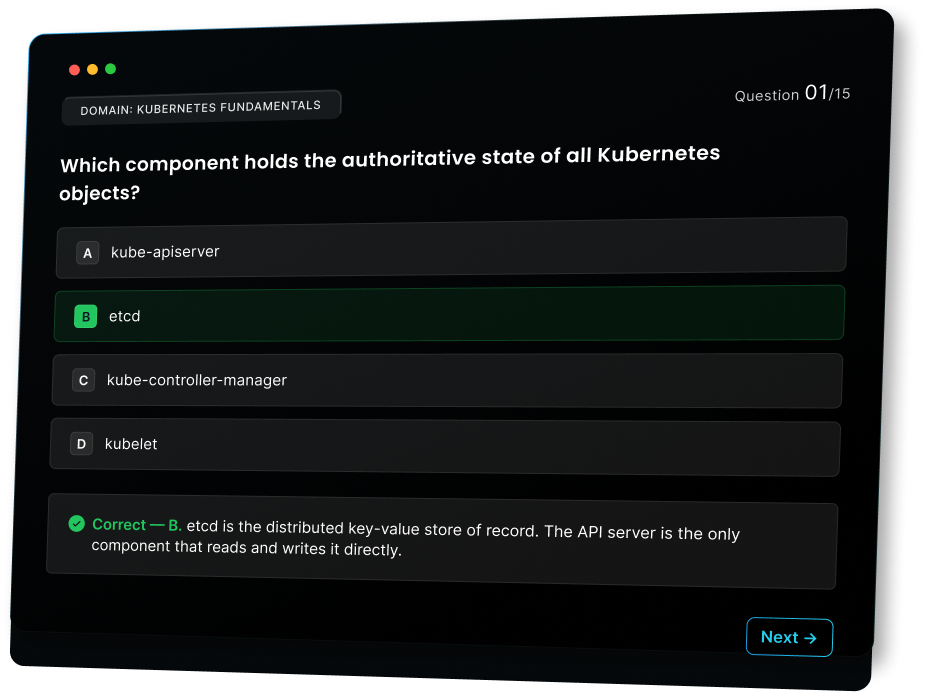
Which control-plane component exposes the Kubernetes API used by kubectl?
kubelet
kube-proxy
kube-apiserver
Container runtime
C
The API server is the control plane's API entry point. The kubelet manages node workloads; kube-proxy and the runtime have different roles.
Kubernetes Fundamentals
1
Select One
DOMAIN Question 01/00

0 of 0 answered
WHY HANDS-ON PRACTICE

Knowledge, Earned by Doing

KCNA rewards broad understanding, not memorized syntax.

Build Real Exam Speed

The KCNA gives you 90 minutes for 60 questions, an average of 90 seconds each. Repeated practice trains you to recognize concepts fast, so you're not re-reading definitions under time pressure.

Know Your Weak Domains

Review every question you missed and spot the topics that need more work. Better to find them here than on exam day.

Realistic Scenario Questions

Exam-style questions, in the multiple-choice format that are a mix of recall and scenario-based items.

‍

Reduce Exam-Day Anxiety

Get comfortable answering KCNA-style multiple-choice questions, so nerves don't cost you marks.

Reinforce Through Repetition

Spaced repetition on frequently tested concepts, like Pods, Services, and the control plane, moves them from look it up to just know it.

Benchmark Against a Passing Score‍

Compare your score with the KCNA’s 75% passing threshold and identify topics to review before exam-day.

HEAR FROM OUR LEARNERS

Real Learners. Real Results

Alhamdulillah 🙏! Thrilled to announce that I am now officially a Certified Kubernetes Administrator (CKA)! While Kubernetes, cluster orchestration, and container security are already central to my daily DevSecOps work, earning this certification is a great validation of those hands-on skills.Thanks to Mumshad Mannambeth and the KodeKloud team—their course and hands-on labs helped me a lot in preparing for this exam.The learning never stops! 🚀

Read Full Post

Imtiaz Ali
DevOps | SRE | Multi-Cloud | DevSecOps

Freshly certified: Certified Kubernetes Administrator (CKA)! 🚀Passing this hands-on, live-terminal exam was a great challenge. Paired with my AWS Certified DevOps Engineer – Professional, it reinforces my focus on bridging enterprise multi-account cloud governance with production-grade Kubernetes runtime operations.A special shoutout and big thank you to Mumshad Mannambeth, the KodeKloud team, and the Cloud Native Computing Foundation (CNCF) and Kubernetes (Official) community. The Certified Kubernetes Administrator (CKA) course was hands-down the best preparation for the live terminal environment! 🛠️Next stop: continuing to build resilient, developer-first platform foundations!

Read Full Post

Gaurav Dubey
Cloud Architect | Platform Engineer | AWS DevOps Pro | CKA

Cherishing one of my dreams - CKS Certified! ✨Last year, in October, when I cracked my CKA, my colleagues asked, “When is CKS?” 😂And I was like… bro. 😅Because it felt so much bigger. I also knew it wasn’t just Kubernetes anymore, but Kubernetes with a special layer of security - yeah, tightened Kubernetes.Back then, I used to look up to CKS like a child gazing at one of the stars in the sky.⭐Now, fast forward to today - I cleared it last week and officially became a Certified Kubernetes Security Specialist (CKS), thanks to the Cloud Native Computing Foundation (CNCF), The Linux Foundation and my company Aivar Innovations. 🎉That moment felt so special, and I’m incredibly grateful to all my colleagues, friends, and family for all the support. ❤️A mention of the resources I used: KodeKloud by Mumshad Mannambeth and Kim Wüstkamp’s CKS courses. I also had my colleagues supporting me with my doubts and anxieties before the exam. 😂Looking forward to applying everything I’ve learned in my work and continuing to grow in the Cloud Native and Kubernetes space. 🚀So, cheers to everyone who dreams, aspires, and inspires. Keep going and keep up the good work! 🥂And as I always say - God, keep it coming!! ✨

Read Full Post

Rima Sidique
DevOps Engineer | AI & DevOps Enthusiast

I've successfully passed CKA certification. Shout-out to Mumshad Mannambeth for his great CKA course and labs and to Omkar Shelke Killercoda CKA scenarios. Links: - https://lnkd.in/eZPVHJeR- https://lnkd.in/eEVyZdaZ

Read Full Post

Gabriel Rodríguez
DevSecOps Engineer

🎉 The Kubernetes journey continues… and this time, happy to say I’m officially a Kubestronaut! 🧑🚀🚀🎖️ 1 out of 242 in France and 1 out of 4217 worldwide!⏳✈️ It’s been quite a journey. From my early days working with Kubernetes, thanks to the opportunity Prof. Timur Friedman gave me to contribute to the EdgeNet project, to securing my internship as a DevOps Engineer at Sonos, Inc. — and fast-forward five years, here I am today, a Senior DevOps Engineer at Sonos, Inc. working extensively with Kubernetes everyday.💌 A special thank you to Jose Alfredo Alvarez Aldana for your support, guidance, and for everything you taught me along the way. I was really lucky to have the opportunity to work alongside you early in my journey. 🙏💯 A big thank you to Mumshad Mannambeth for building KodeKloud! The platform has been incredibly helpful throughout this journey, both for learning and preparing for the exams.And of course, shout out to all the people who supported, challenged, and inspired me along the way. ❤️Never give up 💪Keep smiling 😃

Read Full Post

Rima Sidique
DevOps Engineer | AI & DevOps Enthusiast

Alhamdulillah 🙏! Thrilled to announce that I am now officially a Certified Kubernetes Administrator (CKA)! While Kubernetes, cluster orchestration, and container security are already central to my daily DevSecOps work, earning this certification is a great validation of those hands-on skills.Thanks to Mumshad Mannambeth and the KodeKloud team—their course and hands-on labs helped me a lot in preparing for this exam.The learning never stops! 🚀

Read Full Post
Imtiaz Ali
DevOps | SRE | Multi-Cloud | DevSecOps

Freshly certified: Certified Kubernetes Administrator (CKA)! 🚀Passing this hands-on, live-terminal exam was a great challenge. Paired with my AWS Certified DevOps Engineer – Professional, it reinforces my focus on bridging enterprise multi-account cloud governance with production-grade Kubernetes runtime operations.A special shoutout and big thank you to Mumshad Mannambeth, the KodeKloud team, and the Cloud Native Computing Foundation (CNCF) and Kubernetes (Official) community. The Certified Kubernetes Administrator (CKA) course was hands-down the best preparation for the live terminal environment! 🛠️Next stop: continuing to build resilient, developer-first platform foundations!

Read Full Post
Gaurav Dubey
Cloud Architect | Platform Engineer | AWS DevOps Pro | CKA

Cherishing one of my dreams - CKS Certified! ✨Last year, in October, when I cracked my CKA, my colleagues asked, “When is CKS?” 😂And I was like… bro. 😅Because it felt so much bigger. I also knew it wasn’t just Kubernetes anymore, but Kubernetes with a special layer of security - yeah, tightened Kubernetes.Back then, I used to look up to CKS like a child gazing at one of the stars in the sky.⭐Now, fast forward to today - I cleared it last week and officially became a Certified Kubernetes Security Specialist (CKS), thanks to the Cloud Native Computing Foundation (CNCF), The Linux Foundation and my company Aivar Innovations. 🎉That moment felt so special, and I’m incredibly grateful to all my colleagues, friends, and family for all the support. ❤️A mention of the resources I used: KodeKloud by Mumshad Mannambeth and Kim Wüstkamp’s CKS courses. I also had my colleagues supporting me with my doubts and anxieties before the exam. 😂Looking forward to applying everything I’ve learned in my work and continuing to grow in the Cloud Native and Kubernetes space. 🚀So, cheers to everyone who dreams, aspires, and inspires. Keep going and keep up the good work! 🥂And as I always say - God, keep it coming!! ✨

Read Full Post
Rima Sidique
DevOps Engineer | AI & DevOps Enthusiast

I've successfully passed CKA certification. Shout-out to Mumshad Mannambeth for his great CKA course and labs and to Omkar Shelke Killercoda CKA scenarios. Links: - https://lnkd.in/eZPVHJeR- https://lnkd.in/eEVyZdaZ

Read Full Post
Gabriel Rodríguez
DevSecOps Engineer

🎉 The Kubernetes journey continues… and this time, happy to say I’m officially a Kubestronaut! 🧑🚀🚀🎖️ 1 out of 242 in France and 1 out of 4217 worldwide!⏳✈️ It’s been quite a journey. From my early days working with Kubernetes, thanks to the opportunity Prof. Timur Friedman gave me to contribute to the EdgeNet project, to securing my internship as a DevOps Engineer at Sonos, Inc. — and fast-forward five years, here I am today, a Senior DevOps Engineer at Sonos, Inc. working extensively with Kubernetes everyday.💌 A special thank you to Jose Alfredo Alvarez Aldana for your support, guidance, and for everything you taught me along the way. I was really lucky to have the opportunity to work alongside you early in my journey. 🙏💯 A big thank you to Mumshad Mannambeth for building KodeKloud! The platform has been incredibly helpful throughout this journey, both for learning and preparing for the exams.And of course, shout out to all the people who supported, challenged, and inspired me along the way. ❤️Never give up 💪Keep smiling 😃

Read Full Post
Rima Sidique
DevOps Engineer | AI & DevOps Enthusiast
FAQs

Frequently Asked Questions

Is this practice test free ? 

Yes! This practice test is completely free. You can take it as many times as you like to practice and assess your knowledge.

Do I need to install anything ? 

No. You don’t need to install anything. The practice test is completely browser-based, so you can start practicing directly online. 

What if I'm new to this domain?

That's completely fine , mock tests aren't just for the final week before your exam. Taking one early gives you a baseline: you'll see which topics you already grasp, which ones you've never encountered, and how the real exam frames its questions. Every attempt comes with detailed explanations for each answer, so even the questions you get wrong become a study guide. We'd suggest starting with one full mock test, reviewing the explanations carefully, then working through the linked learning material before attempting the next one. 

How closely does this mock test match the real exam?

The question style and pattern closely mirror the real certification exam, the way scenarios are framed, the answer options, and the level of reasoning required are all modelled on it. The main difference is length: this mock has 25 sample questions, while the actual exam typically presents 50-60 questions of this type. So treat this as a representative sample rather than a full-length simulation. The style will feel familiar on exam day; the stamina and time pressure of a longer paper is something you'll want to prepare for separately.