
AWS
Cloud
DevOps

AWS Certified DevOps Engineer – Professional

Prepare for the AWS Certified DevOps Engineer – Professional exam! Master CI/CD, Infrastructure as Code, resilient architectures, monitoring, incident response, and security through hands-on labs and real-world AWS DevOps scenarios.
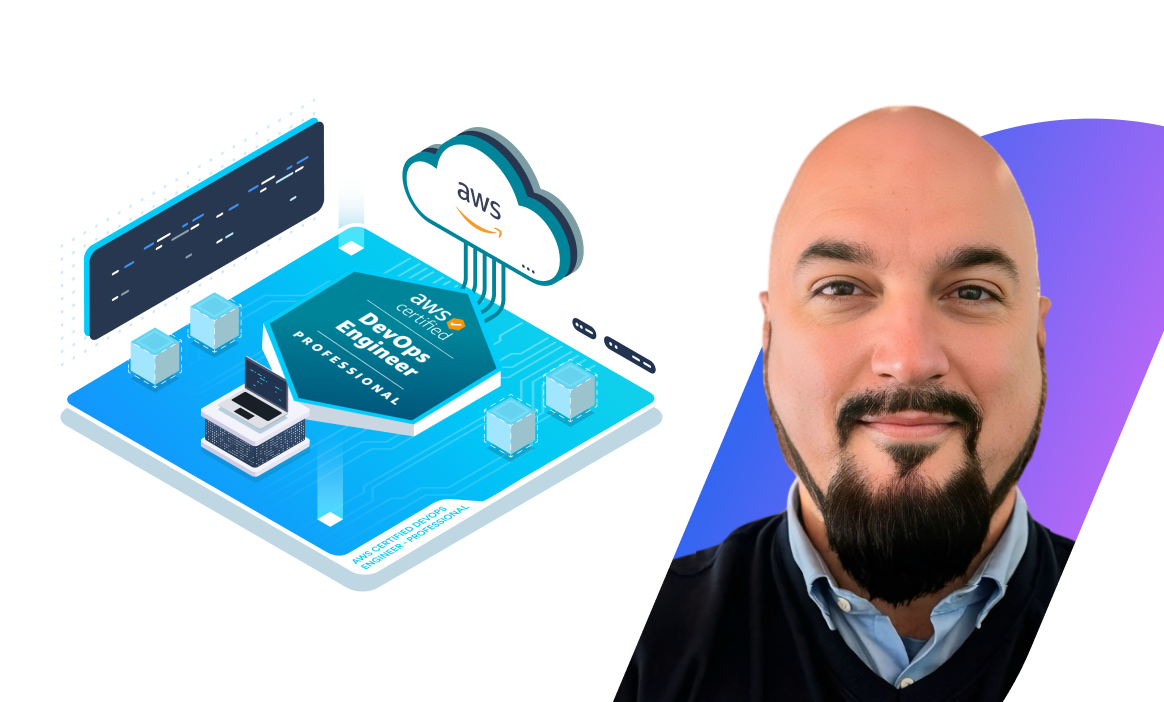
Michael Forrester
Michael Forrester
Lead AWS Cloud Trainer
AWS Certified DevOps Engineer – Professional
Play Button
Fill this form to get a notification when course is released.
book
9
Lessons
book
Challenges
Article icon
202
Topics

What you’ll learn

Our students work at..

Description

Modern cloud applications demand speed, reliability, and scalability, and achieving all three requires strong DevOps practices. From automated deployments to resilient architectures and real-time monitoring, DevOps on Amazon Web Services (AWS) is about building systems that can evolve and operate efficiently at scale.

This is where the AWS Certified DevOps Engineer – Professional certification comes in.

In this course, you’ll learn how to design, implement, and manage robust DevOps workflows on AWS, using industry best practices and real-world scenarios.

What You'll Learn

Domain 1 - SDLC Automation

  • Automate the software development lifecycle using CI/CD pipelines.
  • Manage version control, build processes, secrets, and automated testing.
  • Explore artifact management and deployment strategies across virtual machines, containers, and serverless environments.
  • Troubleshoot CI/CD pipelines and implement advanced configurations.

Domain 2 - Configuration Management and IaC

  • Build and manage Infrastructure as Code (IaC) using AWS CloudFormation.
  • Create reusable templates and manage multi-account and multi-region deployments.
  • Explore advanced IaC concepts using AWS Cloud Development Kit (AWS CDK).
  • Implement configuration management using AWS Systems Manager and apply governance best practices.

Domain 3 - Resilient Cloud Solutions

  • Design highly available and fault-tolerant cloud architectures.
  • Build resilient compute, data, container, and serverless solutions.
  • Improve network scalability and system reliability.
  • Implement disaster recovery strategies to ensure business continuity.

Domain 4 - Monitoring and Logging

  • Monitor AWS environments using observability best practices.
  • Collect, process, and analyze logs at scale.
  • Create metrics, dashboards, and alarms to track system performance.
  • Use tracing and application insights to identify and troubleshoot issues.

Domain 5 - Incident and Event Response

  • Manage operational events and automate incident responses.
  • Troubleshoot system failures and resolve production issues.
  • Implement incident management strategies at scale.
  • Apply chaos engineering techniques to test and improve system resilience.

Domain 6 - Security and Compliance

  • Secure AWS environments using identity and access management best practices.
  • Implement data protection, encryption, and threat detection.
  • Apply network security controls and governance policies.
  • Use auditing and compliance strategies to maintain secure production environments.

Why Learn AWS DevOps?

Organizations are rapidly adopting cloud-native architectures, and the need for skilled DevOps engineers is higher than ever. AWS provides a rich ecosystem of tools for CI/CD, infrastructure automation, monitoring, and security, making it a leading platform for DevOps practices.

Whether you're automating deployments, managing infrastructure as code, or ensuring system reliability, mastering AWS DevOps will help you build scalable, production-ready systems with confidence.

Hands-On Learning

This course is highly practical, with guided labs and real-world scenarios integrated throughout. You’ll gain hands-on experience in:

  • Building and managing CI/CD pipelines
  • Implementing Infrastructure as Code
  • Designing resilient and scalable architectures
  • Monitoring systems and analyzing logs
  • Automating incident response workflows
  • Securing AWS environments and ensuring compliance

Who Should Enroll?

  • DevOps Engineers working on AWS
  • Cloud Engineers and Architects
  • Site Reliability Engineers (SREs)
  • Developers transitioning into DevOps roles
  • Professionals preparing for the AWS Certified DevOps Engineer - Professional exam

Prerequisites

Prior experience with AWS services and basic DevOps concepts is recommended.

Exam Readiness and Certification

This course is designed to help you confidently pass the AWS Certified DevOps Engineer – Professional exam. By the end of the course, you will have deep knowledge of AWS DevOps services, hands-on experience with practical scenarios, and the ability to design and operate automated, secure, and resilient systems.

Through structured domains, practical labs, and exam-focused coverage, you’ll reinforce key concepts across CI/CD, infrastructure as code, monitoring, security, and incident response, so you're fully prepared for both the certification exam and real-world DevOps challenges.

Get Started

If you're ready to take your DevOps skills to the next level and build production-grade systems on AWS, this course is your next step.

Enroll now and advance your journey toward becoming an AWS DevOps expert.

Read More

What our students say

Michael Forrester

About the instructor

Michael Forrester, a DevOps legend with a 23-year career in technology, excels in DevOps, cloud technologies, and Agile methodologies.

At Web Age Solutions, he was a Principal Cloud and DevOps Instructor, shaping training programs. His tenure at Amazon Web Services as a Senior Technical Trainer involved enhancing cloud solutions skills. At ThoughtWorks, in roles like Lead Consultant, he focused on DevOps and platform architecture.

No items found.

Introduction

lock
8
Topics
Lesson Content

Module Content

Introduction03:35
Course Introduction – Prerequisites, Details, Audience, Outcomes, and Structure07:15
Why AWS DevOps Engineer Professional Certification03:41
Demo: Registering/Taking an Exam for the First Time – What to Know07:52
Demo: DevOps Engineer Professional Exam Guide: What to focus on!07:13
Where Are You Now? – Take an Assessment Explained!01:42
Demo: The KodeKloud AWS Playgrounds04:55
Demo: Setting Up Your Own AWS Account – A Walkthrough

Domain 1 - SDLC Automation

lock
42
Topics
Lesson Content

Module Content

Fundamentals of CI/CD Pipelines13:28
Understanding SDLC Concepts, Phases, and Models15:53
GAME: Match the SDLC Phase to its Activities
Single vs Multi-Account Pipelines in AWS11:31
Using Git Repositories With AWS (Where Is CodeCommit?)06:36
Demo: Simple CI/CD Pipeline With GitHub and CodePipeline13:10
Lab: Build Your First Pipeline
Game: Pipeline Patterns for Single- vs Multi-Account or Multi-Stage Designs
CodeBuild and the Buildspec file11:35
Demo: Basic Buildspec Usage15:40
Lab: Custom Build Environments With Docker and CodeBuild
Storing Secrets on AWS07:06
Demo: Secrets in CodeBuild Using Secrets Manager and SSM Parameter Store13:20
Lab: Secure Build Process With Secrets
Game: Identify Security Issues in These Pipelines
Types of Automated Test in a CI/CD Pipeline03:53
Lab: Integration and Load Testing With CodeBuild
Game: Match the Test Type With the Pipeline Stage
Lab: Health Checks and Exit Codes in Your Pipeline
Artifact Lifecycle and Secure Storage for Code07:12
Demo: Storing Artifacts in CodeArtifact07:41
Lab: Managing Build Artifacts
Demo: EC2 Image Builder in Action12:28
Deployment Methods for EC2, ECS, EKS, and Lambda – Overview09:04
Game: Match Deployment Method With Deployment Need
Demo: ECS Deployment Methods in Action11:32
Lab: ECS Fargate in Our Pipeline
Lab: EKS Deployment Using Canary via CodeDeploy
Demo: Serverless Deployments and Traffic Shifting With Lambda11:50
Storage Patterns for Deployment Artifacts and Applications07:36
Demo: IAM and Cross-Service Permissions for CodeArtifact and S311:09
Lab: End-to-End Multi-Stage Deployment Through dev Test and Production Using Canary Rollout
Immutable vs Mutable Deployments10:30
Demo: Immutable Infrastructure With CloudFormation11:30
Lab: Immutable Deployment Using CloudFormation
Blue/Green Deployments for Multi-Service Applications05:16
Troubleshooting Common Failures in Advanced Deployments04:50
Demo: Debugging a Failed Deployment06:38
Lab: Pipeline Triage – Fix Your Failing Pipeline
Lab: Refine Your Full Git to Production Pipeline
Game: Solve Your Misconfigurations to Restore Your Pipeline
Quiz: What do you already know about SDLC Automation?

Domain 2 - Configuration Management and IaC

lock
33
Topics
Lesson Content

Module Content

What Is Infrastructure as Code for AWS?05:20
Game: Why Do We Value IaC?
Configuration Management in AWS10:27
Demo: AWS Config for Basic Resource Inventory08:24
Lab: Enable and Explore AWS Config
The Basics of CloudFormation15:40
Demo: Building Your First Stack11:25
Lab: Create and Update a CloudFormation Stack
Game: CloudFormation Puzzle
Configuration Drift and Stack Policies05:54
Demo: Drift Detection in CloudFormation06:08
Modularizing CloudFormation Templates09:36
Demo: Nested Stacks in CloudFormation17:27
Lab: Building Shared Modules With Nested Stacks
Enforcing Best Practices With cfn-lint, CloudFormation Guard, and Automated Checks04:40
Game: Finding Anti-Patterns in Your CloudFormation
Multi-Account Strategies07:18
Demo: CloudFormation StackSets11:50
AWS Control Tower and Account Governance04:00
Demo: Control Tower and AWS Organizations15:29
Game: Multi-Region Puzzle on StackSets and Control Tower
The AWS CDK – Overview07:29
Demo: Building With the CDK10:41
Systems Manager Overview – Eighteen Subservices of SSM07:32
Demo: State Manager and the Run Command Services09:14
AWS AppConfig: Dynamic App Configuration04:56
Demo: Rolling Out Config Changes With AppConfig08:20
Service Catalog and Reusable Templates05:52
Demo: Service Catalog Portfolio06:00
Enforcing Governance With AWS Config11:37
Lab: Governance at Scale
Game: Audit and Secure Your CloudFormation Stack With AWS Config
Quiz: What do you know about Configuration Management and IaC?

Domain 3 - Resilient Cloud Solutions

lock
23
Topics
Lesson Content

Module Content

Resilience Concepts 101 in AWS08:30
Game: Resilience Terminology
Identifying Single Points of Failure09:10
Demo: Basic Multi-AZ Setup Using Instance Deployments05:44
EC2 Auto Scaling and Load Balancing08:36
Demo: Autoscaling From Idea to Scale in EC217:19
Lab: Scale Your Web Tier
RDS High Availability Options11:08
Demo: RDS Multi-AZ + Read Replicas12:08
Game: Choose the Right Database HA Strategy
NoSQL HA With DynamoDB10:16
Demo: DynamoDB Global Table08:01
ECS and EKS Resiliency Considerations15:14
Demo: ECS With Multi-AZ16:56
Lambda and Serverless High Availability10:08
Edge Services for CloudFront, Functions, and Lambda @ Edge04:48
Demo: With and Without CloudFront15:58
Global Services for Failover: Global Accelerator and Route 5305:57
DR Concepts: RTO/RPO, Pilot Light, Warm Standby, and ACtive/ACtive16:58
Demo: Cross-Region Backup and Replication16:58
Demo: Route 53 and Global Accelerator for DR Failover29:01
Game: Pick the DR Pattern
Quiz: What do you know about implementing and maintaining resilient solutions?

Domain 4 - Monitoring and Logging

lock
32
Topics
Lesson Content

Module Content

Why Metrics, Logs, and Traces Matter14:57
Game: Terminology Match
Demo: Core AWS Monitoring Tools (CloudWatch, X-ray, Config, and CloudTrail06:52
CloudWatch Logs and Log Insights – Beyond the Basics13:32
Demo: Pushing Custom Metrics to CloudWatch Logs07:18
Lab: Setting Up Custom Log Collection Using CloudWatch Agent
Demo: Setting Up Custom Log Retention and Encryption13:05
Game: Log Architecture and Puzzle
Subscription Filters and Log Streams to Kinesis, Lambda, and OpenSearch07:24
Demo: Kinesis Data Streams for Log Ingestion13:03
Game: Log Routing Challenge
Demo: CloudWatch Metrics and Namespaces06:06
Demo: Publishing Custom Metrics03:56
Demo: CloudWatch Dashboards and Widgets09:20
Advanced CloudWatch Alarms With Anomaly Detection and Alarm Conditions12:30
Demo: Configuring Advanced Alarms and Notifications23:02
Lab: Alarming on Custom Metrics
Event-Driven Notifications08:36
Game: Alarm Tuning
AWS X-Ray for Tracing08:54
Demo: Instrumenting an App With X-ray09:04
Lab: X-ray With a Sample App
CloudTrail for API Logging05:33
AWS Config and Detective Work08:36
Lab: AWS Config and Drift Detection
Game: Investigate the Incident
CloudWatch Log Insights11:17
Demo: Real-Time Log Analysis With Insights09:07
Lab: Write Custom Insights Queries
EventBridge for Automated Responses08:59
Game: Responder Puzzle
Quiz: What do you know about implementing monitoring and logging solutions?

Domain 5 - Incident and Event Response

lock
25
Topics
Lesson Content

Module Content

Why Incident and Event Response Matter06:42
GAME: Incident Terms
Services for Incident Response – Overview08:29
AWS Health and Personal Health Dashboards08:19
Demo: Subscribing to AWS Health Events07:26
Lab: Health Event Notification
Game: Event Source Quiz
Amazon EventBridge and SNS18:52
Demo: EventBridge Rule to SNS and Lambda17:21
Lab: Event-Driven Fan-Out
Game: Event Routing Puzzle
AWS Systems Manager Automation10:43
Demo: Remediation Runbook04:32
Lab: Automated Patching
Demo: AWS Config Auto-Remediation15:54
Game: "Fix the Non-Compliance"
Systematic Troubleshooting13:43
Demo: Debugging and EC2 Outage08:44
Lab: Broken Deployment Triage
Game: Root Cause Mystery
OpsCenter and Incident Tracking07:30
Demo: OpsCenter Integration07:34
Game: Incident Triage
Demo: AWS Fault Injection Simulator12:40
Quiz: What do you know about implementing incident and event response?

Domain 6 - Security and Compliance

lock
29
Topics
Lesson Content

Module Content

Shared Responsibility and Security Pillars08:11
Beyond the Basics of IAM07:34
Multi-Account Security With AWS Organizations14:19
Demo: Setting Up SCPs and OUs With AWS Organizations09:09
Demo: Cross-Account Roles and How to Assume Them13:26
IAM: Policy Debugging With IAM12:12
Federation and Single Sign-On12:06
Demo: AWS Identity Center Setup10:01
Lab: Applying Roles to Instances
Game: Which Authentication Patterns Are Recommended?
AWS KMS and Customer Managed Keys08:16
Demo: S3 and EBS Using KMS and SSE07:51
Lab: Implement Envelope Encryption
Secrets Management in AWS for RDS15:11
Game: Encryption Puzzle
AWS Config and Auto Remediation09:52
Demo: Config Rules for Compliance09:41
Security Hub and Consolidating Findings in AWS12:41
Game: Governance Scenario
Amazon GuardDuty – Threat Detection in AWS09:23
Demo: GuardDuty Alerts09:44
Amazon Macie – Watching S3 for PII10:32
Game: Incident or Normal Behavior?
Demo: Network Security From Ingress to APP on AWS09:32
CloudTrail and Security Auditing08:11
Demo: Querying CloudTrail With Athena07:22
Lab: Detect Unauthorized Changes
Game: "Who Did It?" Find the Culprit for Your Suspicious Activity
Quiz: What do you know about implementing security and compliance automation?

Summary

lock
6
Topics
Lesson Content

Module Content

Summary of Domain 1: SDLC Automation07:48
Summary of Domain 2: Configuration Management and IaC06:27
Summary of Domain 3: Resilient Cloud Solutions07:35
Summary of Domain 4: Monitoring and Logging11:26
Summary of Domain 5: Incident and Event Response06:17
Summary of Domain 6: Security and Compliance05:58

Mock Exams

lock
4
Topics
Lesson Content

Module Content

Mock Exam - 1
Mock Exam - 2
Mock Exam - 3
Thank You and Closing Credits03:41

Frequently Asked Questions

Who are KodeKloud courses for?

KodeKloud courses are designed for learners at different skill levels, from beginners to experienced IT professionals looking to develop or strengthen their technical skills.

Do KodeKloud courses include hands-on practice?

Yes. Many KodeKloud courses include hands-on labs and practical exercises that let you apply what you learn in real-world environments.

Do I need any prior experience to take a KodeKloud course?

Prerequisites vary by course. Each course page provides information about the recommended knowledge or experience you may need before starting.

Can I learn at my own pace?

Yes. KodeKloud courses are designed for self paced learning, so you can learn according to your schedule and revisit lessons and practice activities as needed.

Can I access KodeKloud courses on mobile devices?

Yes. KodeKloud can be accessed through supported web browsers and mobile devices, allowing you to learn from different devices.

Do KodeKloud courses provide certificates?

Certificate availability depends on the course and your KodeKloud plan. Check the individual course page or your account for the applicable certificate details.

How long does it take to complete a KodeKloud course?

Course completion time varies depending on the course length, your prior experience, and how much time you spend on hands-on practice.

Can I practice while taking the course?

Yes. Courses that include hands-on labs allow you to practice concepts as you progress through the lessons.

 How do I start learning a KodeKloud course?

Choose a course that matches your learning goals, review its requirements and curriculum, and select the available subscription option to start learning.

AWS Certified DevOps Engineer – Professional
Play Button
AWS Certified DevOps Engineer – Professional
Fill this form to get a notification when course is released.
This course comes with hands-on cloud labs
9
Modules
Lessons
202
Lessons
Course Certificate
23.12
Hours of Video
Hours of Labs
Story Format
Videos
Case Studies
Demo
Labs
Cloud Labs
Mock exams
Quizzes
Discord Community Support
Community support
Closed Captions

Expand Your Skills in Other Domains

Top-rated KodeKloud courses across popular technology tracks

More Courses From

Michael Forrester

View instructor profile
No items found.
AWS
Cloud
DevOps
close