

Building Kubernetes FinOps AI Agent



What you’ll learn
Our students work at..


Description
This course helps you build an AI agent that audits your Kubernetes cluster against a cost-tagging policy and turns each violation into a ticket. You start in the middle of a production incident at SkyLine Air, a fictional airline example used throughout the course. You trace the problem to a namespace, then get stuck because nobody can tell who owns the workloads running in it. The fix takes minutes, but finding the owner takes much longer. You’ll debug the incident yourself and write an incident report.
From there, the course works back to the cause. When Kubernetes workloads lack ownership and cost labels, incidents take longer to resolve, and cloud bills can’t be traced back to a team. The problem grows as you scale, but it isn’t unique to SkyLine Air; even teams at companies like Uber have run into such problems. You’ll learn enough FinOps to fix it: the three phases of FinOps, why FinOps for AI has become its own discipline, and why a tagging policy should live in code as YAML instead of in spreadsheets or dashboards.
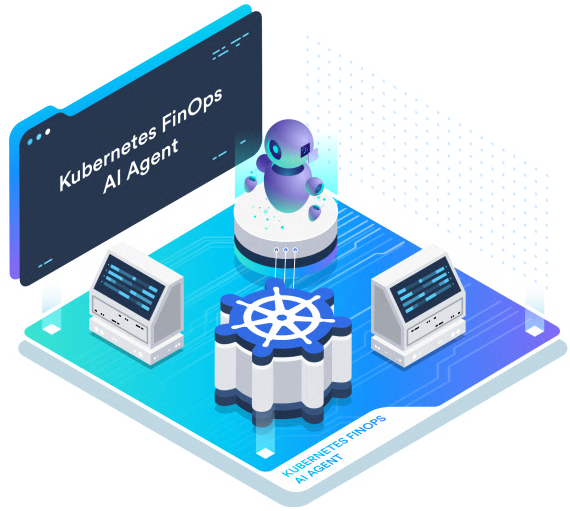
The rest of the course is hands-on. You’ll deploy SkyLine Air’s services into a Kubernetes cluster with a separate namespace for each business unit. Then you’ll build an AI agent with LangChain and connect it to the cluster through a Model Context Protocol (MCP) gateway. The agent audits the cluster’s labels, reads SkyLine Air’s tagging rules, and uses a large language model (LLM) to judge each workload against the policy. The course ends with the agent opening actionable tickets in a FinOps issue tracker, so the findings reach the people who can act on them. Each major step includes a whiteboard session on the design and a short lecture on the trade-offs: why MCP and LangChain, when you’d pick something else, and where letting an LLM judge policy can go wrong.
What You’ll Learn
Incident Response and FinOps Foundations
- Debug a Kubernetes production incident and trace it back to missing ownership labels.
- Write a short, structured incident report.
- Apply the three FinOps phases to Kubernetes cost visibility.
- Define a tagging policy as code in YAML.
Connecting an AI Agent to Kubernetes
- Deploy a multi-namespace application and inspect its labels.
- Set up an MCP gateway and validate its connection to a Kubernetes cluster.
- Build a LangChain agent that calls Kubernetes tools over MCP.
Policy Auditing and Ticketing
- Build a policy-aware auditor agent that checks labels against your tagging rules.
- Handle truncated tool output from the agent.
- Connect the agent to an issue tracker so each finding becomes a ticket.
- Adapt the workflow to your own organization.
Hands-On Learning
The course includes eight hands-on labs, where you’ll gain experience in:
- Verifying and debugging the SkyLine Air incident
- Deploying the SkyLine Air infrastructure
- Connecting MCP to the Kubernetes cluster
- Building your first LangChain MCP agent
- Auditing workload labels
- Running the policy auditor
- Running the full agent with the issue tracker
Who Should Enroll?
- DevOps engineers, platform engineers, and site reliability engineers (SREs) running Kubernetes in production
- FinOps and cloud cost engineers who need to trace costs back to workload owners
- Developers who want to build a practical AI agent on top of real infrastructure
Build an AI agent that turns your Kubernetes tagging policy into automated audits and actionable tickets, and learn the FinOps practices that keep cloud costs traceable to their owners.
Prerequisites
Prior experience with basic Python and Kubernetes, including namespaces, deployments, labels, and kubectl, is recommended. You don’t need prior experience with FinOps, MCP, or LangChain.
What our students say

About the instructor
Raghunandana Krishnamurthy is a seasoned Staff Data Engineer and MLOps expert, skilled in navigating both GCP and AWS cloud platforms to accelerate model development and deployment. His experience spans modernizing legacy data systems, architecting hybrid infrastructures, and ensuring data quality for diverse applications. He used to hold Associate AWS Solution Architect certification, Cloudera Hadoop Admin certification, Airflow certification, and Databricks Lakehouse certification
A technical leader and passionate trainer, Raghunandana excels at building and maintaining big data platforms, championing DevOps best practices, and fostering team alignment. With hands-on expertise in tools like SageMaker, VertexAI, Prometheus, Grafana, and extensive DevOps tools focusing on Data Engineering and MLOps.

Introduction

The Problem Statement
Introduction to FinOps
Setting Up SkyLine Air Kubernetes Services
MCP Gateway for Kubernetes
LangChain MCP Agents
LLM Policy-Aware Label Audit
From Findings to Actionable Tickets
Frequently Asked Questions
Who are KodeKloud courses for?
KodeKloud courses are designed for learners at different skill levels, from beginners to experienced IT professionals looking to develop or strengthen their technical skills.
Do KodeKloud courses include hands-on practice?
Yes. Many KodeKloud courses include hands-on labs and practical exercises that let you apply what you learn in real-world environments.
Do I need any prior experience to take a KodeKloud course?
Prerequisites vary by course. Each course page provides information about the recommended knowledge or experience you may need before starting.
Can I learn at my own pace?
Yes. KodeKloud courses are designed for self paced learning, so you can learn according to your schedule and revisit lessons and practice activities as needed.
Can I access KodeKloud courses on mobile devices?
Yes. KodeKloud can be accessed through supported web browsers and mobile devices, allowing you to learn from different devices.
Do KodeKloud courses provide certificates?
Certificate availability depends on the course and your KodeKloud plan. Check the individual course page or your account for the applicable certificate details.
How long does it take to complete a KodeKloud course?
Course completion time varies depending on the course length, your prior experience, and how much time you spend on hands-on practice.
Can I practice while taking the course?
Yes. Courses that include hands-on labs allow you to practice concepts as you progress through the lessons.
How do I start learning a KodeKloud course?
Choose a course that matches your learning goals, review its requirements and curriculum, and select the available subscription option to start learning.
Get access to KodeKloud’s all courses.
Get access to KodeKloud’s all Pro courses.
Get access to our Labs now!
190+
1280+
75+


Expand Your Skills in Other Domains
AWS Certified Cloud Practitioner (CLF-C02)




GCP Cloud Digital Leader Certification
AZ-104: Microsoft Azure Administrator

DevOps Pre-Requisite Course

Fundamentals of DevOps
DevOps Interview Preparation Course
AI Infrastructure: LLM-D, vLLM and GPUs
AI-900: Microsoft Certified Azure AI Fundamentals
AI Agents Fundamentals

Kubernetes for the Absolute Beginners – Hands-on Tutorial
Certified Kubernetes Administrator (CKA)
Certified Kubernetes Security Specialist (CKS)
AWS Solutions Architect Associate Certification

AWS Lambda